This article summarizes the approach taken by independent reviewers and industry experts regarding stairlift evaluations, providing a practical 2025 guide for comparing brands, planning installation, estimating costs, and upgrading home safety. Read on to learn how these devices are evaluated and what steps to take to choose and install the right model for your home and mobility needs.
Why Independent Reviews Matter for Stairlifts
Finding a reliable stairlift involves more than just looking at a price tag; it requires a deep look at how these machines hold up over years of daily use. Consumer Reports and similar independent organizations remain primary resources for shoppers in the United States because of their commitment to objective data. These organizations generally do not accept free samples from manufacturers, often purchasing products at retail prices to ensure results are not influenced by corporate partnerships or advertising dollars. For a product that combines mechanical parts with electrical systems and professional installation, this level of scrutiny is vital.
The methodology used by industry experts is thorough. It often involves analyzing long-term reliability data and owner satisfaction surveys. While manufacturers conduct their own lab tests—simulating years of wear in a matter of weeks by running motors under heavy load—independent reviewers aggregate data from thousands of real users who have lived with these devices for years. This feedback reveals long-term reliability trends that a short factory test might miss, such as which brands tend to have failing sensors or gear racks after the warranty expires.
The Value of Independent Data
When you look at a stairlift, you see a chair and a rail. Under the surface, there are complex safety circuits and drive systems. Independent data helps you understand if a specific model is prone to frequent repairs. This is especially important because a broken stairlift can leave a person stranded on one floor of their home. By tracking owner satisfaction, reviewers provide a roadmap of which companies stand behind their products. You can find a synthesis of these findings in guides like The Consumer Reports Best Stair Lifts of 2025 which highlights brands that consistently score high in durability.
Strengths and Limitations of the Data
While ratings are excellent for comparing hardware durability and safety features—such as seatbelt usability or obstruction sensor sensitivity—they have limits. National reviews cannot easily rate the quality of your local installer, which is a critical variable. A stairlift is only as good as the person who bolts it to your stairs; if the rail is not aligned perfectly, even the highest-rated lift will ride roughly. Furthermore, general guides struggle to provide exact costs for curved rail systems, as these are highly customized and prices vary based on the specific turns in your home.
| What Independent Reviews Reveal | What National Data May Not Capture |
|---|---|
| Mechanical durability and motor life | Skill level of the local technician |
| Battery backup reliability | Exact pricing for custom curved stairs |
| Ease of use for the controls | Responsiveness of local repair branches |
| Long term brand satisfaction trends | Performance of brand new, untested models |
Integrating Expert Advice
You should not use these ratings in a vacuum. The best approach is to combine technical data with input from a medical professional. An occupational therapist can tell you if a specific seat height or swivel mechanism fits your physical needs. While a lift might get a high score for its remote controls, those controls might be too small for someone with severe arthritis. Use the ratings to narrow down your brand list, then get at least three local quotes. Ask those installers for references from customers who have had their lifts for more than two years to bridge the gap between a good machine and a good service experience.
Checking Dates and Updates
Mobility products do not change as fast as smartphones, so it is common to see data that is a year or two old. However, you must check the date of the review to ensure the model is still in production. If you find a review from a few years ago, it is still useful for judging the brand’s overall reliability, as brands like Bruno or Stannah tend to keep their core designs for a long time. For broader context on making your home accessible, consider relevant advice on how to stay in your home safely as you age.
Cross-Referencing for the Full Picture
Always cross-reference lab results with recent user feedback. Websites that aggregate buyer experiences can show if a company’s service quality has dropped recently. For instance, looking at the 3 Best Stair Lift Companies of 2025 | Reviewed by Buyers can give you a sense of current customer service wait times. If a brand is durable but recent users complain about long delays for parts, factor that into your decision. A reliable machine is useless if you have to wait three weeks for a simple battery replacement. Check the manufacturer’s service network to see if they have factory-trained technicians in your specific zip code.
How Stairlifts Are Tested and Key Performance Factors
Engineers use rigorous protocols to determine which stairlifts hold up under daily pressure. Load testing is the most basic measure of structural integrity; weights exceeding the official rating are placed on the seat to ensure the rail or motor housing does not crack under stress. High-quality units are typically built with a safety factor of at least 1.5 times the stated limit. Endurance cycles are another major part of the process, where a machine runs up and down a test rail up to twenty thousand times without stopping to mimic decades of use. If a plastic gear or circuit board fails early, the model receives a low durability score.
Safety Systems and Emergency Response
Braking and Overspeed Governors
Braking performance is a matter of life and death. Every lift has a primary motor brake, but experts look for a secondary mechanical brake called an overspeed governor. If the motor fails and the chair starts to slide, this governor locks the carriage to the rail instantly. Testers measure the exact distance the chair travels before it stops; a safe stop should happen within a few inches to ensure the user is never at risk of a free fall.
Obstruction Sensors
Safety sensors are pressure plates located on the footrest and the sides of the carriage. They must stop the lift immediately if they touch an object, preventing the machine from crushing a stray shoe, a pet, or a toy. Experts test these sensors from multiple angles to ensure there are no blind spots. Actionable Tip: When evaluating a model in a showroom or during a home visit, ask the installer to demonstrate how the safety sensors react to an object placed on the track. According to the NCOA, these features are essential for seniors to regain independence safely.
Battery Backup and Power Out Behavior
Modern stairlifts are battery powered and plug into a standard outlet to keep the batteries charged. If your house loses power, the lift should still work for roughly 10 to 20 trips. Experts check the battery capacity and the location of the charging points. Some models have “continuous charging” strips along the entire rail, which is superior because the battery stays full even if you park the chair in the middle of the stairs. Other models only charge at the top or bottom. Actionable Tip: During your final training session, test the lift while it is unplugged to verify the backup system performs as expected.
Technical Components and Drive Types
| Component | Expert Evaluation Factor |
|---|---|
| Drive System | Rack and pinion is preferred for reliability |
| Track Design | Aluminum for straight, custom steel for curved |
| Weight Limit | Standard is 300 lbs, heavy duty is up to 600 lbs |
| Speed Control | Smooth start and stop to prevent jerking |
| Remote Calls | Range and signal strength through walls |
Rack and Pinion vs Cable Drive
The drive system is the heart of the machine. Most modern brands like Bruno use a rack and pinion setup, involving a toothed rail and a gear on the motor. It is highly reliable and requires less maintenance than older cable drives, which can stretch or fray over time leading to a bumpy ride. Experts almost always recommend rack and pinion for long-term home safety.
Weight Capacity and Derating
Weight capacity is not a fixed number for every home. On a straight track, a lift might handle 400 pounds, but if that same motor is used on a steep curved track, the capacity might drop to 350 pounds (known as derating). Experts look at how the motor handles the physics of a turn. Always choose a model with a capacity well above the user’s actual weight to reduce wear on the motor.
Ergonomics and Real World Comfort
Swivel Seat Ease
The swivel seat is a critical ergonomic feature, allowing the user to face the landing when getting off. Manual swivels use a lever, while power swivels do the work automatically. Experts test the force required to move these levers; for a person with arthritis, a stiff lever is a major obstacle. A smooth swivel makes the transition from the chair to the floor much safer.
Control Ergonomics
The joystick or toggle switch should be easy to use with a thumb or a palm, requiring no tight gripping. Testers also check the remote call/send functions, which allow you to call the lift to your floor. The buttons should be large and have a clear tactile click. You can find detailed charts on these features at Lifeway Mobility.
Noise and Vibration
A quiet lift is a sign of good engineering. Labs use decibel meters to measure motor noise at ear level; a quiet unit stays under 50 decibels. Vibration is measured with sensors on the seat, as any jerking or shaking indicates poor rail alignment or a weak motor. A smooth ride is vital for users with chronic back pain or balance issues.
Maintenance and Lifespan Benchmarks
Common Wear Points
A quality stairlift should last ten to fifteen years, though specific parts require attention. Batteries are the most common wear point and usually need replacement every three to five years. Gears need a specific type of grease to stay quiet; a grinding noise typically indicates the gears are wearing down. Upholstery can also wear out, especially if the lift is near a sunny window.
Maintenance Schedules
Experts suggest a professional service call once a year to check the tightness of rail bolts, lubricate moving parts, and test emergency brakes. For heavy users, a six-month checkup is better. Keeping the rail clean of dust and pet hair with a dry cloth is the best way to extend the life of the rollers. As noted in the Williams Lifts summary, regular maintenance is key to avoiding expensive repairs. Actionable Tip: Check the annual service fee for brands like Lifeway Mobility to factor it into your long-term budget.
Comparing Brands, Models, and Value in 2025
Choosing a stairlift in 2025 requires evaluating the total value over several years rather than just the initial sticker price. Major global brands like Stannah and Handicare compete with strong US-based companies like Bruno and Harmar. Installer networks such as Lifeway Mobility or Leaf Home provide the local support needed for maintenance, often making them more important than the brand itself because they handle the actual service calls.
Evaluating Brand Networks and Manufacturers
Bruno Independent Living Aids
A major player in the US market, Bruno is known for high build quality and custom rail designs. Many experts consider them a top choice for overall value, praising their units for being robust and reliable. You can find more details on their standing in the 3 Best Stair Lift Companies of 2025 reviews.
Stannah Stairlifts
Stannah is a premium brand with a long history, focusing on design and ease of use. Their rails are often slimmer than competitors, and they offer a wide range of upholstery options to match home decor. They are frequently cited for excellent craftsmanship and a strong reputation for safety.
Acorn and AmeriGlide
Acorn is known for fast installation using a modular rail system that fits most straight stairs quickly. AmeriGlide focuses on affordability, offering options for self-installation which can lower the entry price. However, self-installation requires technical skill and might affect the warranty. You can compare these brands in the Compare the Best Stair Lift Brands of 2025 guide.
Harmar and Handicare
Harmar specializes in heavy-duty models and comfortable seating. Handicare offers innovative features like the 1100 model, which uses a multi-drive system to ensure the lift keeps moving even if one motor fails. These brands are often available through large dealer networks like Lifeway Mobility.
Key Differentiators in 2025
Build Quality and Rail Design
The materials used in the chassis and rail determine the lifespan of the unit. All-metal construction is generally preferred over plastic components. Straight rails are usually made of aluminum and cut to length on-site. Curved rails are more complex; some brands use custom-fabricated steel rails bent in a factory to match your specific staircase, while others use modular sections bolted together. Custom rails offer a smoother ride but take longer to produce.
Service Networks and Warranties
The size of the dealer network determines how quickly a technician can reach your home. A brand might have a great product, but if the nearest technician is three hours away, you may wait days for a repair. Warranty coverage varies significantly; some brands offer lifetime warranties on the motor or gearbox, while others provide shorter terms like two to five years. Actionable Tip: Always check if the warranty includes labor or just parts. Labor costs for repairs can be high without a service contract.
Understanding Pricing and Cost Drivers
Straight versus Curved Tracks
The shape of your stairs is the biggest factor in the final bill. Straight stairlifts are the most affordable, typically costing between $2,500 and $5,500 including installation. Curved stairlifts are much more expensive because the rail must be custom-made. These systems often start at $8,000 and can exceed $15,000 for complex layouts with multiple landings. See a breakdown of these costs in the 9 Best Stair Lifts of 2025 (With Costs) report.
Installation and Labor Rates
Professional installation is standard for most reputable brands. Complexity affects labor cost; narrow stairs or homes with old electrical systems might require extra work. Regional labor rates in major cities will be higher than in rural areas. Most homeowners spend between $2,500 and $10,000 for a professionally installed system. Outdoor models also carry a premium, adding $2,000 to $5,000 to the base price for weatherproofing.
Affordability, Insurance, and Financing
Purchase and Financing
Buying a new unit is the most common path. Many dealers offer financing plans to help spread the cost over several years, making a $4,000 investment feel more like a monthly utility bill. Some companies provide low-interest or even no-interest periods for qualified buyers.
Insurance Coverage
A common question is whether Medicare covers stairlifts. Typically, Medicare does not cover them as they are viewed as home modifications rather than essential medical equipment. However, some private long-term care insurance policies or VA benefits may provide partial reimbursement depending on your specific plan. Actionable Tip: Contact your insurance agent to ask specifically about coverage for “durable medical equipment” or “home accessibility upgrades.”
Rentals and Subscriptions
If you only need a lift for a few months during recovery, a rental is a smart choice. Rental fees usually include a setup charge and a monthly payment. Some companies have started offering subscription models that include all maintenance and repairs in a single monthly fee, providing peace of mind against surprise bills. Note that curved lifts are rarely available for rent because the rails are custom-made.
Refurbished and Used Units
Buying a used stairlift can save significant money. Reputable dealers often sell reconditioned units that have been inspected and tested, usually coming with a limited warranty. Avoid buying used lifts from private sellers online, as it is difficult to ensure the safety of a unit that was not professionally removed and reinstalled. Reconditioned units from brands like AmeriGlide can start as low as $1,999.
Calculating Long Term Value
Cost Per Year of Use
To find the true value, calculate the cost per year. A $5,000 lift that lasts ten years costs $500 per year, whereas a cheaper $3,000 lift that breaks down after four years costs $750 per year. You must also factor in service plans, which often cost between $150 and $300 annually. High-quality brands like Bruno or Stannah often have higher upfront costs but lower long-term maintenance needs.
Total Cost of Ownership
The total cost includes the purchase price, installation, electricity, and maintenance. Most lifts use very little power, but batteries usually need replacement every three to five years. When comparing models, look at independent scores for reliability and owner satisfaction, balancing them against the reputation of the local installer. For a broad look at top-rated options, check The Best Stair Lifts of 2025.
Planning Your Stairlift Installation and Home Safety Upgrades
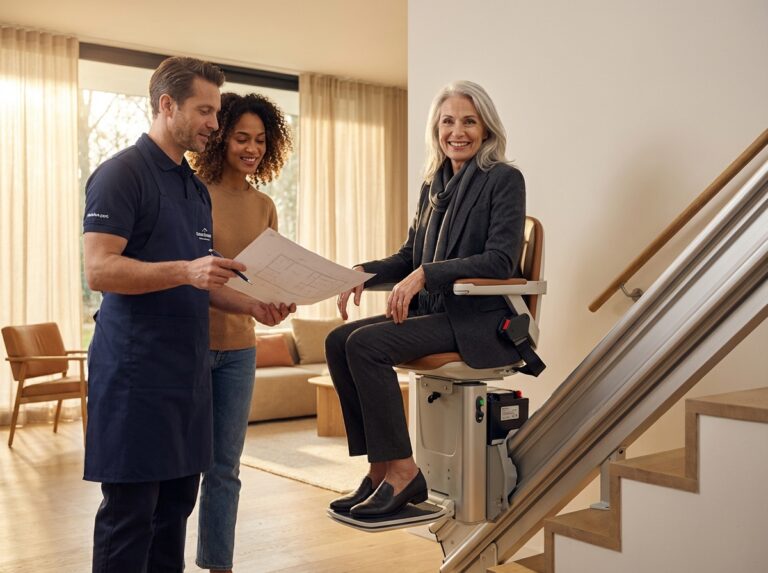
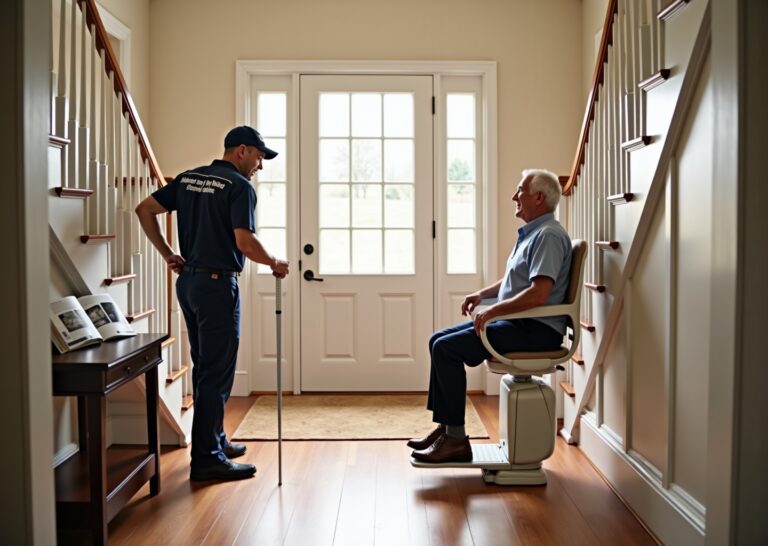
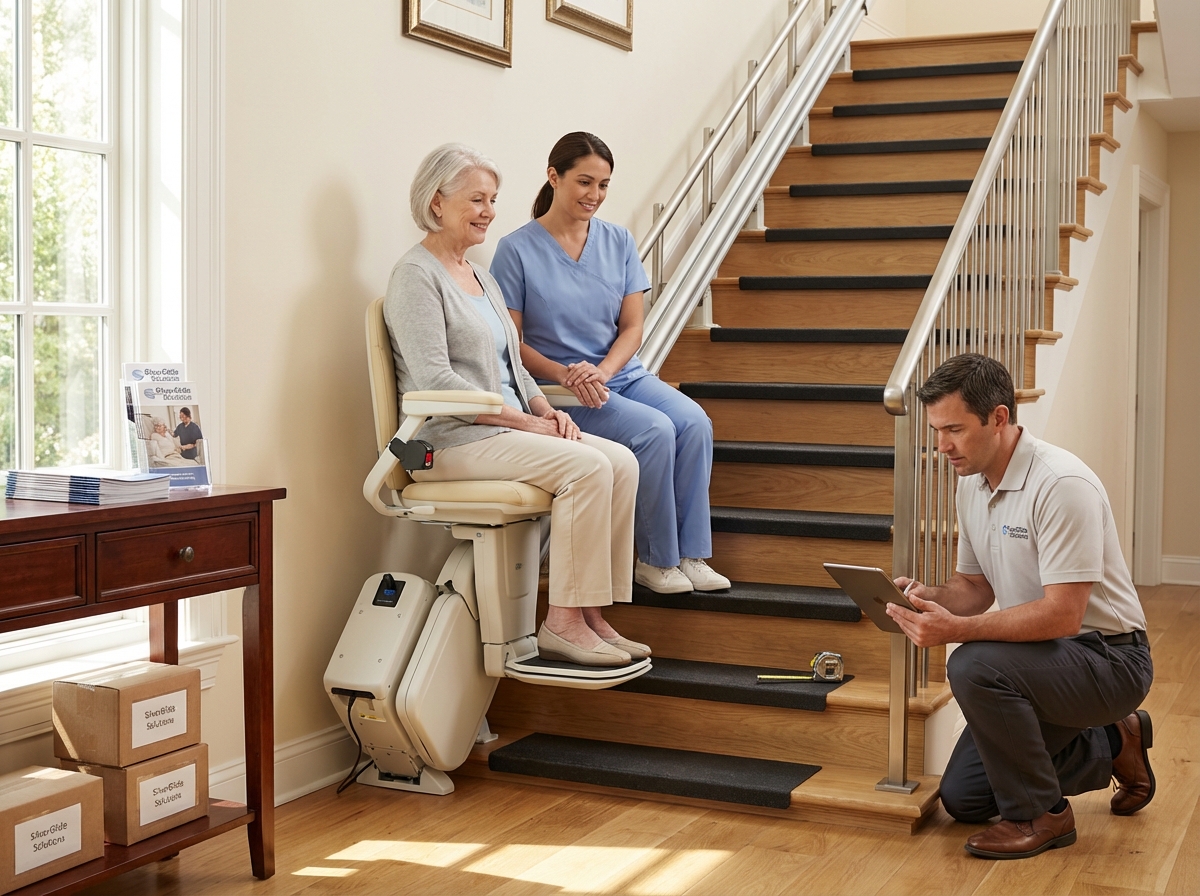
A successful stairlift installation starts with a professional site survey. A technician will use specialized tools to measure the exact pitch of your staircase and check the width to ensure the chair has enough clearance for your knees and feet. Most standard stairlifts require at least 29 to 32 inches of width. The surveyor looks for obstructions like low-hanging light fixtures, radiators, or thick windowsills, and measures headroom to ensure safety. They also examine doorways; if a door is too close to the landing, a folding rail is often the best solution to prevent trip hazards.
Choosing the Right Rail and Power Setup
Rail Selection
You must decide between a straight or curved rail based on your home layout. Straight rails are for simple flights with no turns, while curved rails are custom-made to fit the exact contours of your home. You might also choose between single-rail and dual-rail designs; single rails often look more modern, while dual rails are frequently used for heavy-duty models. Actionable Tip: If you require a curved rail, request a 3D rendering of how it will look in your hallway before signing the contract.
Electrical and Carpentry Needs
Stairlifts run on batteries that charge when the unit is parked. The technician will plan for a standard 110v outlet near the top or bottom of the stairs to provide a constant trickle charge; a dedicated circuit is rarely needed. Some homes require minor carpentry, such as removing a handrail or trimming a baseboard to ensure the rail sits as close to the wall as possible.
Pre-Installation Preparation
Preparing your home before the technician arrives makes the process faster. Clear all items from the stairs, including decorative rugs, plants, or pictures hanging at shoulder height. Move furniture near the landings to give the installer room to work. Inform everyone in the household about the schedule, as the stairs will be inaccessible for several hours. If you have pets, keep them in a separate room to prevent accidents, and ensure the path from the front door to the stairs is clear for carrying heavy rail sections.
What to Expect on Installation Day
A standard straight installation usually takes about three to four hours, while curved systems may take a full day due to complex rail sections. The technician begins by securing rail brackets directly to the stair treads (not the wall), protecting your drywall. Once the rail, carriage, and seat are mounted, they run the lift to test sensors and limit switches. Finally, they provide a full safety briefing, showing you how to use the swivel seat, seatbelt, and remote controls. Actionable Tip: Confirm the arrival window and expected duration with the technician a day before the appointment.
Removal and Resale Considerations
A common concern is what happens when the lift is no longer needed. Since the rail is bolted to the treads, removal is relatively simple, leaving small holes in the carpet or wood that can be repaired. Actionable Tip: Ask the installer during the initial quote if they offer a buy-back program or a professional removal service for a flat fee. This can save hassle and expense later.
Pairing Your Lift with Home Safety Upgrades
A stairlift works best as part of a broader safety plan. Improve lighting around landings with motion-activated LED strips to prevent falls during transfers. Apply non-slip treads to remaining stair space and contrasting tape to the edge of the top step for visibility. If landings are small, consider widening the area or removing clutter. These Consumer Reports tips on home adaptations offer guidance for making your entire house safer. You might also reinforce existing handrails on the opposite side of the lift for extra support.
Building Codes and Professional Advice
Stairlift installations must follow local building codes. Some municipalities require a permit and inspection. Your installer should handle these details, but verify this during the quote process. If you have complex health needs, consult an occupational therapist to evaluate your range of motion and suggest features like a power swivel seat. If significant structural changes are needed, hire a licensed contractor to handle modifications before the stairlift company arrives.
Final Recommendations and Next Steps
Moving forward with a stairlift purchase requires shifting from general research to specific home planning. Start by gathering the most recent manufacturer specifications and comparing them against independent data. Look closely at weight capacities and seat dimensions; models from brands like Bruno or Stannah offer different seat widths, which are vital if the staircase is narrow or the user requires extra space.
Getting at least three on-site quotes from certified installers is a priority. Do not rely on phone estimates. A technician must visit to measure the rise and run of the stairs and identify obstructions. This visit is also your chance to evaluate the professionalism of the local dealer. You can find reputable companies through resources like Modernize to compare installers in your area.
During these surveys, ask specific questions about the warranty. Some manufacturers provide a lifetime warranty on the motor but only a limited period for electronics. Crucially, ask if the warranty includes labor costs. Many companies offer a three-year parts warranty but only one year for labor. You need to know your potential out-of-pocket costs if a sensor fails after the first year.
Service response times are just as important as the initial price. Ask the dealer about their typical wait time for a repair visit. If the stairlift is the user’s only way to move between floors, a three-day wait is unacceptable. Look for companies offering emergency service on weekends and holidays. Some premium brands offer service plans that include annual maintenance and priority scheduling.
You should prioritize safety and reliable local service over the lowest initial price. A stairlift is a major investment in home accessibility. Choosing a brand with a strong reputation for durability ensures the lift remains a helpful tool for years. Focus on the long-term value of a dependable machine and a responsive support team to provide the best protection for your mobility and peace of mind.
Next Steps Checklist
Research Ratings and Local Reviews
Read the latest independent data on brand reliability. Check customer feedback on ConsumerAffairs to see how local dealers handle installations and repairs.
Schedule Three Site Surveys
Contact certified installers for in-person measurements. Request written quotes that include the cost of the unit, labor, and any necessary permits.
Consult with Medical Professionals
Talk to an occupational therapist if the user has specific physical limitations. They can recommend features like a standing lift or a heavy-duty model.
Compare Financing and Grants
Look into payment plans offered by dealers. Check for local state programs or veterans benefits that might assist with the cost of home modifications.
Establish a Final Budget
Include the purchase price and the cost of environmental safety upgrades. Set aside funds for annual maintenance and potential battery replacements in the future.
Sources
- 9 Best Stair Lifts of 2025 (With Costs) — We reviewed 11 stair lift companies and tested 18 models. From that, we found the nine best stair lifts for seniors.
- Best Stairlift Brands of 2025 for Safe Home Mobility — Compare the best stairlift brands of 2025. See costs, features, and installers to find a safe, comfortable lift for your staircase.
- 3 Best Stair Lift Companies of 2025 | Reviewed by Buyers — Bruno Independent Living Aids wins our pick for overall value. Customers mention price positively in 99% of Bruno reviews on ConsumerAffairs.
- The Consumer Reports Best Stair Lifts of 2025 — Here is our synthesis of the best stairlifts of 2023. The best stair lifts of 2023 include Bruno, AmeriGlide, Acorn, Harmar, Access BDD, and Stannah.
- Compare the Best Stair Lift Brands of 2025 — We rode 10 different stair lifts. These are the best stair lifts of 2025, based on our in-person testing.
- The Best Stair Lifts of 2025 — Leaf Home, Bruno, and Acorn offer the best stair lifts for seniors based on safety and price, with Leaf Home rated best overall, Bruno best for warranty, …
- 2025's Buyer's Choice Awards: Stair Lifts — The ConsumerAffairs Buyer's Choice Awards for stair lifts are here! We used feedback and reviews from customers like you to choose our winners.
- Best Stairlifts Consumer Reports — 1. Stannah 260 Curved Stairlift · 2. Flow X by Access BDD · 3. Platinum Ultimate Curved Stairlift · 4. Handicare 1100 Straight Stairlift.
- Compare Best Stair Lifts of 2025 — In the charts below, you'll be able to compare features, benefits, warranty coverage, and more across several different stairlift product models.
- Stay in your home — Looking to stay in your home for a long time? Consumer Reports has great tips on home adaptions that will ensure your home ages well as you get older.
EMPTY